Tetris Scoring Explained: Points, Lines and Speed Levels
Published · 3 min read
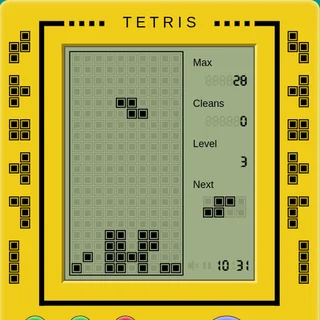
The version of Tetris on this site is React Tetris, the Brick Game handheld remake by chvin. Its scoring is short enough to learn in a minute, and once you know it you will play differently. Here is every number, taken from the game's own code.
Points for every piece
Each piece that lands adds points, whether or not it clears a line. On speed 1 a piece is worth 10 points. Every speed level above 1 adds 2 more, so a piece is worth 12 on speed 2, 14 on speed 3 and 20 on speed 6. That does not sound like much, but over a long game it adds up: two hundred pieces on speed 6 is 4,000 points before you have cleared a single row.
Points for line clears
Clearing rows is where the real score comes from. The game pays:
- 1 line: 100 points
- 2 lines: 300 points
- 3 lines: 700 points
- 4 lines at once: 1,500 points
Look at the jump. Four single lines are worth 400. The same four lines cleared together with one I piece are worth 1,500, almost four times as much. Two doubles make 600. If score matters to you, clearing four at once is the only plan that really pays.
One thing this version does not do is multiply line points by the level. A four-line clear is 1,500 on speed 1 and 1,500 on speed 6. Only the points per piece go up with speed.
How the speed rises
You choose your starting speed on the setup screen with the left and right arrows, from 1 to 6. During the game the speed goes up one step for every 20 lines you clear, counted from the start of the game, until it reaches 6. Start on speed 1 and you reach speed 2 at 20 lines, speed 3 at 40 and so on. Start on speed 4 and you are at the top speed after 40 lines.
The speeds are fall times. On speed 1 a piece drops one row every 800 milliseconds; then 650, 500, 370, 250 and finally 160 milliseconds on speed 6. Speed 6 is five times faster than speed 1, and from about speed 4 there is no time to think once a piece appears.
Start lines do not change the scoring
Up and down on the setup screen add 0 to 10 rows of random junk at the bottom. They make the game harder because you have less room and have to dig, but they do not add any bonus. They are there for practice and for a challenge, not for points.
What this means in practice
- Build for fours. Stack nine columns evenly and keep the tenth empty. When the long piece comes, drop it in for 1,500.
- Do not be greedy when it is high. Pieces are chosen at random, so the I piece can stay away. If the stack passes the middle of the screen, take whatever lines you can and rebuild.
- A higher start speed is worth it once you are steady. Each piece is worth more, and you skip the slow early part of the game.
- Hard drop to save time, not for points. Space sends the piece to the bottom at once, but it gives no extra score here. Its value is that it gets the next piece moving sooner.
A worked example
Say you start on speed 2 with no junk rows and play 100 pieces before the stack gets away from you. Those pieces alone are worth about 1,200 to 1,500 points, because the speed creeps up as you clear lines. Now compare two ways of clearing 40 lines. Clear them all as singles and they add 4,000. Clear them as ten four-line clears and they add 15,000. Same pieces, same number of lines, nearly four times the score. That one choice matters more than anything else in this version.
The price is risk. Keeping a column open means the rest of the stack sits higher while you wait, and on speed 5 or 6 a tall stack can end a game in a few seconds. A good habit is to build for fours while the stack is below the middle of the screen and to switch to taking any lines you can once it climbs past it.
The ceiling
The score display stops at 999,999. Your best score is saved in the browser and shown as Max on the screen, next to your last round, so you always know the number to beat.
More from the blog
- Playing Tetris on a School Chromebook: Keys, Touch Buttons and Saves
How to set up this Tetris on a Chromebook or phone: which keys do what, how the touch buttons work, why it pauses by itself and how it saves your game.